Bayou St. Jean
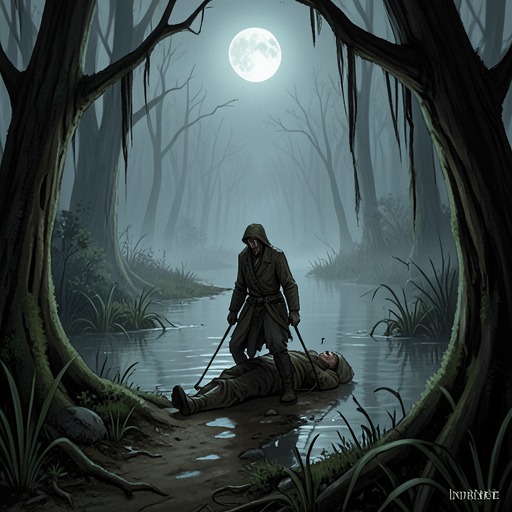
Interview with the VampireBayou St. Jean is the dark swamp landscape outside New Orleans to which Louis and Claudia take Lestat’s remains after Claudia’s attack. Its flooded roads, cypress walls, muck, and approaching dawn make it more than a hiding place: it becomes the threshold where Louis tries to bury the material evidence of his former life and nearly allows himself to disappear with it.
Setting and Physical Character
Louis reaches Bayou St. Jean by carriage, driving beyond the gas-lit gates of the country houses toward the swamp stretching in the direction of Lake Pontchartrain. The shell road narrows and becomes rutted, while the swamp rises on both sides as an apparently impenetrable wall of cypress and vine. The journey is accompanied by the smell of muck and the rustling of animals, replacing the ordered streets of New Orleans with a landscape that is dark, difficult to traverse, and increasingly removed from human society.
The setting is defined by unstable boundaries. Road gives way to ooze, carriage travel gives way to wading, and the living world of houses and lights gives way to water, vegetation, and hidden animal movement. Bayou St. Jean therefore supplies a physical form for the uncertain state Louis enters after Lestat’s apparent destruction: neither ordinary domestic life nor settled vampire existence, but a submerged region where identity and intention lose their former clarity.
Disposal of Lestat’s Remains
After Claudia kills Lestat, she wraps his body in a sheet and decorates it with long-stemmed chrysanthemums. The corpse has become almost weightless, limp and cordlike, and carries a sweet, funereal smell as Louis lifts it from the carriage. The flowers make the body resemble a formal burial object even as the act itself is clandestine and desperate; beauty and concealment are bound together in the same bundle.
Louis carries the remains away from the place where he had already laid the two boys. He descends into the dark water, with the water rising into his boots while his feet search for a path through the ooze. The swamp resists the clean finality of burial. Lestat does not enter a grave or a coffin but is lowered into slimy water, where the white sheet becomes an indistinct pale shape beneath the surface. The body is thus materially erased without becoming spiritually or emotionally absent.
Louis’s Crisis at the Water
As dawn approaches, Louis can barely see the road and sky. He stands shaken above the submerged sheet and recognizes the remains as those of Lestat, the figure who had represented transformation and mystery. The recognition strips the disposal of its practical purpose: what Louis has placed in the water is not merely evidence to be hidden but the physical remains of the relationship and supernatural order that shaped his existence.
The swamp then becomes the site of an inward summons toward annihilation. Louis feels a powerful pull urging him to descend into the darkness and let everything disappear. The impulse is presented as stronger than ordinary articulated voices, as though the landscape and the submerged corpse have opened a route toward self-erasure. Claudia’s call interrupts that movement. Through the tangled vines, Louis sees her as a distant, tiny white flame on the faintly luminous road, and he turns back toward her rather than following Lestat into the water.
Connection to Claudia and the House of Death
The journey to Bayou St. Jean follows Claudia’s practical management of the aftermath. She helps remove Lestat from the house, while Louis also carries away the bones of the mother and daughter Claudia had killed, which had been left in the unused kitchen stove. The swamp therefore receives the accumulated remains of several concealed deaths, not only Lestat’s. Its darkness absorbs the consequences of the household’s violence and the failures of its inhabitants to control one another.
The site also contrasts with the domestic space from which they depart. Inside the house, blood stains the carpet, Claudia’s dress, her shoes, and her cheek, while Louis is paralyzed by what has happened. At Bayou St. Jean, Claudia remains silent beside him during the ride and later embraces him in the coffin, repeating that she loves him and that they are free of Lestat. The swamp thus marks both a physical escape from danger and the beginning of a new enclosure: freedom from Lestat is immediately joined to Louis and Claudia’s intensified bond.
Narrative Significance
Bayou St. Jean gives concrete form to the novel’s recurring traffic between contamination and purification. Bodies, blood, bones, flowers, water, and fire are repeatedly used to manage the boundary between the hidden supernatural household and the mortal world. Here, however, water does not cleanse Louis. It conceals Lestat’s remains while exposing Louis to grief, guilt, and the temptation to follow the dead.
The location’s decisive significance lies in this reversal. Louis arrives intending to dispose of a corpse, but the swamp makes him confront what the corpse means. Its physical barriers slow the journey, its water makes burial indistinct, and its approaching dawn compresses the available time. Bayou St. Jean becomes the landscape of a failed disappearance: Lestat is submerged, but Louis is recalled by Claudia and returns to consciousness, carrying the unresolved consequences of the killing with him.